

Radiation Medicine × Medical Imaging × AI

Painless treatment,
kept painless.

PIL develops medical image processing and AI software for radiation medicine: radiotherapy and diagnostic imaging.
Our software tracks the tumor itself in X-ray images, with nothing implanted, preserving the gentleness radiotherapy was always meant to have without giving up precision.

Kinder medicine, for patients and staff.

Venture certified by the National Institutes for Quantum Science and Technology (QST)

What we do

Tracking the tumor itself,
with nothing implanted.

We provide radiotherapy systems (X-ray, proton and carbon-ion) with software that sees and follows the tumor inside the body.
One goal: precise treatment that stays painless.

01

Radiotherapy is treatment
without cutting or pain.

Cancer is treated by directing radiation from outside the body, with no incision. No anesthesia, bleeding or hospital stay as with surgery. This is the original strength of radiotherapy.

02

Yet for precision, needles
are sometimes put into the body.

To target tumors in the lung or liver that move with breathing, metal markers are sometimes implanted as landmarks. This carries a risk of complications and adds waiting time before treatment. It runs opposite to the idea of painless treatment.

03 — PIL's answer

We track the tumor itself
in the images, with no markers.

Our software finds the tumor's shadow directly in X-ray fluoroscopy and follows its breathing motion with 0.5 mm accuracy. Nothing needs to be implanted. Precise, and still painless: a return to the origin of radiotherapy.

For the patientConventional high-precision approach (marker implantation)PIL markerless tracking
Procedure on the body×Needle or catheter insertionNone
Risk of complications×About 3% (e.g. pneumothorax)Zero
Time to start treatment×Days of waiting after implantationNo waiting
Who can be treatedOnly patients who can receive markersAlso those who cannot
Targeting accuracyHigh0.5 mm (equal or better)

* 0.5 mm accuracy (95% CI) and ~3% marker-implantation complication rate: Mori S, et al. Int J Radiat Oncol Biol Phys 2016;95:258-266; Imura M, et al. Int J Radiat Oncol Biol Phys 2005. “The only product that keeps treatment painless at high precision” is based on PIL’s own survey (September 2026).

Team

Leading experts in the field,
gathered in one place.

Researchers, developers and medical professionals who have worked at the forefront of radiation medicine have come together here, independent of any device manufacturer or hospital. A small group that helped shape this field turns research results into technology that works in the clinic.

50+

Patents in Japan and abroad
(including exclusive licenses to QST intellectual property)

100+

Peer-reviewed papers in English
Continuing to publish frontier research

* Certified as a venture by the National Institutes for Quantum Science and Technology (QST) in November 2020.

Developers from radiotherapy equipment manufacturers

Engineers who built the image-guidance and image-processing systems installed on treatment machines.

Developers from diagnostic imaging manufacturers

Members with hands-on experience developing diagnostic imaging equipment.

Software engineers from medical device manufacturers

Practical experience developing products under international medical device standards such as IEC 62304 and ISO 13485.

Staff involved in international guidelines

Members active in PTCOG, the international particle therapy community, and in drafting ICRU reports, the international standards for radiotherapy.

Clinical members who know the hospital floor

People with experience in diagnostic imaging, radiotherapy and medical physics design technology that is usable in practice, from the very start of development.

A researcher ranked among the world’s top 2%

Our CTO is listed in the Stanford University / Elsevier “World’s Top 2% Scientists List 2025”. A track record of turning image-guided radiotherapy research into technology used in the clinic underpins our work. Our team also includes a recipient of the Commendation for Science and Technology by Japan’s Minister of Education, Culture, Sports, Science and Technology (Research Category).

CLINICAL

Clinical expertise

Diagnostic imaging, radiotherapy, medical physics — members who know the clinical field first-hand.

TECHNOLOGY

Technology

Image analysis, image processing, computer vision, artificial intelligence (AI), augmented reality (AR), and voice recognition.

OUTCOME

Outcome

Benefits to patients and a reduced burden on medical staff — that is our answer.

Why PIL

Bridging medicine and engineering.
Where clinical meets technology.

Read why PIL

Image-guided radiotherapy

Making the invisible
visible.

Image processing quantifies the position and shape of tumors and organs that staff cannot see, aligns the patient to the millimeter at every session, and follows the breathing. Our technology supports that entire flow.

STEP 01

See inside the body.

X-ray, CT, MRI — image processing quantifies the position and shape of tumors and organs that staff cannot confirm visually.

STEP 02

Align to the millimeter.

Patient positioning for every treatment session. 2D-3D/3D-3D registration ensures treatment accuracy.

STEP 03

Follow the breathing.

Image-guided respiratory-gated treatment and AI automation reduce the burden on patients and medical staff.

Business

Our Business

We achieve high precision and efficiency in medical care through our medical image processing technology, which can be introduced to diagnostic imaging equipment (X-ray, CT, MRI, PET, etc.) and radiation therapy equipment (X-rays, proton beams, carbon ions).

RADIOTHERAPY

Radiotherapy

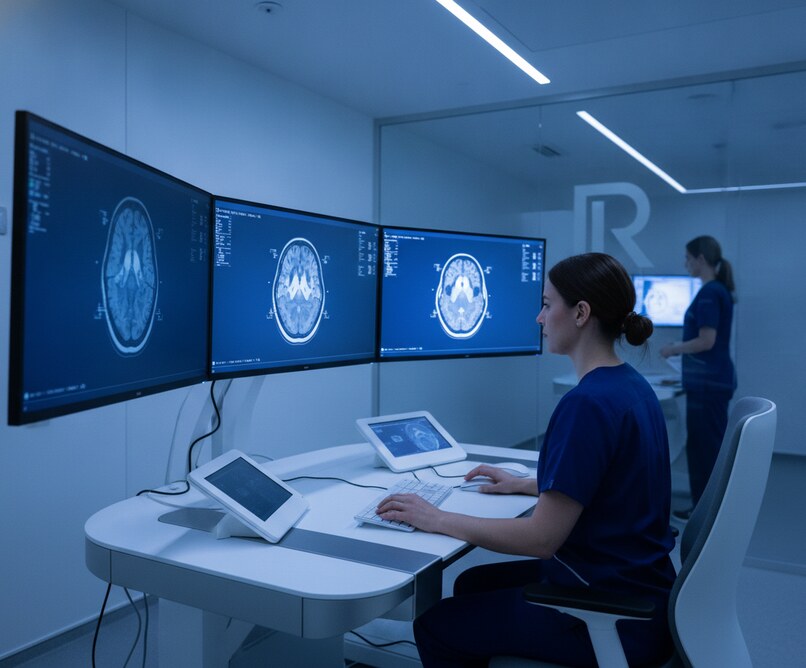
Image Guided Radiotherapy (IGRT) visualizes the location and shape of tumors and organs that cannot be confirmed visually, expressing quantitative values for uncertainties previously estimated by experience. We develop software for patient positioning at every treatment session, high-precision image-guided respiratory-gated therapy, plus automatic contouring, deformable registration, and deep-learning-based treatment planning automation.

Learn more
Radiotherapy
Diagnostic imaging

DIAGNOSIS

Diagnostic imaging

Development of computer-aided diagnosis (CAD), CT/MR image processing and generation, and image artifact correction — with a particular focus on the cardiovascular field.

Healthcare AI workforce

EDUCATION

Healthcare AI workforce

Medical AI training that makes effective use of the clinical field at our affiliated medical facilities, solving real problems through joint research with medical institutions.

Strategic Technical Assistance

CONSULTING

Strategic Technical Assistance

Supporting product development for medical device and AI manufacturers with our expertise in medical imaging + AI and clinical experience, plus guidance for research and academic writing.

Learn more

Contact

Let's solve medical imaging,
together.

Joint research, product development support, careers — feel free to get in touch.

Contact us